TopStudy

Đáp án và lời giải

Bài tập Tích vô hướng của hai vecto có đáp án

Về trang đề

Câu 1

Hướng dẫn chấm do TopStudy biên soạn, mang tính gợi ý

Số đo góc giữa BC→\overrightarrow{BC} và BD→\overrightarrow{BD} là góc CBD bằng 300^{0}.

Xét tam giác BCD, có:

BCA^=CBD^+CDB^⇔CDB^=BCA^−CBD^=800−300=500\widehat{BCA}=\widehat{CBD}+\widehat{CDB}\Leftrightarrow \widehat{CDB}=\widehat{BCA}-\widehat{CBD}={80}^{0}-{30}^{0}={50}^{0}

Suy ra số đo góc giữa DA→\overrightarrow{DA} và DB→\overrightarrow{DB} là góc CDB bằng 500^{0}.

Vậy số đo góc giữa BC→\overrightarrow{BC} và BD→\overrightarrow{BD} bằng 300^{0}, số đo góc giữa DA→\overrightarrow{DA} và DB→\overrightarrow{DB} là góc CDB bằng 500^{0}.

Câu 2

Hướng dẫn chấm do TopStudy biên soạn, mang tính gợi ý

Góc giữa hai vectơ bằng 00^{0} khi hai vecto cùng hướng.

Góc giữa hai vectơ bằng 1800^{0} khi hai vecto ngược hướng (hoặc đối nhau).

Câu 3

Hướng dẫn chấm do TopStudy biên soạn, mang tính gợi ý
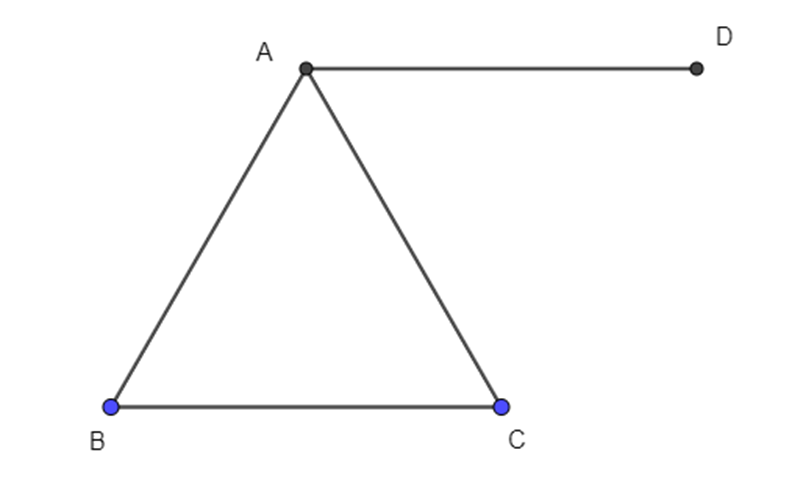
Hình minh hoạ

Lấy điểm D thỏa mãn ABCD là hình bình hành, khi đó: AD→=BC→.\overrightarrow{AD}=\overrightarrow{BC}.

Vì tam giác ABC đều nên ABC^=ACB^=BAC^=600\widehat{ABC}=\widehat{ACB}=\widehat{BAC}={60}^{0}

⇒DAC^=ACB^=600\Rightarrow \widehat{DAC}=\widehat{ACB}={60}^{0} (hai góc so le trong)

⇒BAD^=1200\Rightarrow \widehat{BAD}={120}^{0}

Ta có: (AB→,BC→)=(AB→,AD→)=BAD^=1200(\overrightarrow{AB},\overrightarrow{BC})=(\overrightarrow{AB},\overrightarrow{AD})=\widehat{BAD}={120}^{0}.

Vậy (AB→,BC→)=1200(\overrightarrow{AB},\overrightarrow{BC})={120}^{0}.

Câu 4

Hướng dẫn chấm do TopStudy biên soạn, mang tính gợi ý
Tích vô hướng của hai vecto u→,v→≠0→\overrightarrow{u},\overrightarrow{v}\ne \overrightarrow{0} được tính bởi công thức sau:

u→.v→=∣u→∣.∣v→∣.cos(u→,v→).\overrightarrow{u}.\overrightarrow{v}=|\overrightarrow{u}|.|\overrightarrow{v}|.c\text{os}(\overrightarrow{u},\overrightarrow{v}).

Vì ∣u→∣>0,∣v→∣>0|\overrightarrow{u}|>0,|\overrightarrow{v}|>0 nên dấu của u→.v→\overrightarrow{u}.\overrightarrow{v} phụ thuộc vào dấu của cos(u→,v→)c\text{os}(\overrightarrow{u},\overrightarrow{v}).

Nếu tích vô hướng của hai vecto u→,v→\overrightarrow{u},\overrightarrow{v} là một số dương thì cos(u→,v→)>0.c\text{os}(\overrightarrow{u},\overrightarrow{v})>0. Do đó góc giữa hai vecto u→,v→\overrightarrow{u},\overrightarrow{v} là góc nhọn hoặc bằng 00^{0}.

Nếu tích vô hướng của hai vecto u→,v→\overrightarrow{u},\overrightarrow{v} là một số âm thì cos(u→,v→)<0.c\text{os}(\overrightarrow{u},\overrightarrow{v})<0. Do đó góc giữa hai vecto u→,v→\overrightarrow{u},\overrightarrow{v} là góc tù hoặc bằng 1800^{0}.

Câu 5

Hướng dẫn chấm do TopStudy biên soạn, mang tính gợi ý
Ta có: u→.v→=∣u→∣.∣v→∣.cos(u→,v→)\overrightarrow{u}.\overrightarrow{v}=|\overrightarrow{u}|.|\overrightarrow{v}|.c\text{os}(\overrightarrow{u},\overrightarrow{v})

⇔(u→.v→)2=[∣u→∣.∣v→∣.cos(u→,v→)]2=u→2.v→2.cos2(u→,v→)\Leftrightarrow {(\overrightarrow{u}.\overrightarrow{v})}^{2}={[|\overrightarrow{u}|.|\overrightarrow{v}|.c\text{os}(\overrightarrow{u},\overrightarrow{v})]}^{2}={\overrightarrow{u}}^{2}.{\overrightarrow{v}}^{2}.c{\text{os}}^{2}(\overrightarrow{u},\overrightarrow{v})

Để (u→.v→)2=u→2.v→2{(\overrightarrow{u}.\overrightarrow{v})}^{2}={\overrightarrow{u}}^{2}.{\overrightarrow{v}}^{2} thì cos2(u→,v→)=1⇔[cos(u→,v→)=1cos(u→,v→)=−1⇔[(u→,v→)=00(u→,v→)=1800c{\text{os}}^{2}(\overrightarrow{u},\overrightarrow{v})=1\Leftrightarrow [\begin{matrix}c\text{os}(\overrightarrow{u},\overrightarrow{v})=1 \\ c\text{os}(\overrightarrow{u},\overrightarrow{v})=-1\end{matrix}\Leftrightarrow [\begin{matrix}(\overrightarrow{u},\overrightarrow{v})={0}^{0} \\ (\overrightarrow{u},\overrightarrow{v})={180}^{0}\end{matrix}

Vậy khi góc giữa hai vecto u→,v→\overrightarrow{u},\overrightarrow{v} là 00^{0} hoặc 1800^{0} thì (u→.v→)2=u→2.v→2.{(\overrightarrow{u}.\overrightarrow{v})}^{2}={\overrightarrow{u}}^{2}.{\overrightarrow{v}}^{2}.

Câu 6

Hướng dẫn chấm do TopStudy biên soạn, mang tính gợi ý
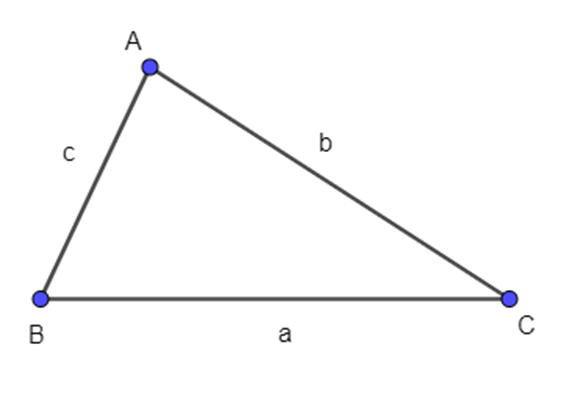
Hình minh hoạ

Ta có:

AB→.AC→=AB.AC.cos(AB→.AC→) ⇒AB→.AC→=AB.AC.cos⁡BAC^ ⇒AB→.AC→=bc.cosBAC^\overrightarrow{AB}.\overrightarrow{AC}=AB.AC.c\text{os}(\overrightarrow{AB}.\overrightarrow{AC})\ \Rightarrow \overrightarrow{AB}.\overrightarrow{AC}=AB.AC.\cos \widehat{BAC}\ \Rightarrow \overrightarrow{AB}.\overrightarrow{AC}=bc.c\text{os}\widehat{\text{BAC}}

Theo định lí côsin, ta có:

cosBAC=b2+c2−a22bc ⇒AB→.AC→=bc.b2+c2−a22bc=b2+c2−a22\text{cosBAC=}\frac{{b}^{2}+{c}^{2}-{a}^{2}}{2bc}\ \overrightarrow{\Rightarrow AB}.\overrightarrow{AC}=bc.\frac{{b}^{2}+{c}^{2}-{a}^{2}}{2bc}=\frac{{b}^{2}+{c}^{2}-{a}^{2}}{2}.

Vậy AB→.AC→=b2+c2−a22.\overrightarrow{AB}.\overrightarrow{AC}=\frac{{b}^{2}+{c}^{2}-{a}^{2}}{2}.

Câu 7

Hướng dẫn chấm do TopStudy biên soạn, mang tính gợi ý

a) Ta có: u→=0→⇒{x=0y=0\overrightarrow{u}=\overrightarrow{0}\Rightarrow \{\begin{matrix}x=0 \\ y=0\end{matrix}

Mà 0→\overrightarrow{0} vuông góc với mọi vecto nên ta có: u→.v→=0\overrightarrow{u}.\overrightarrow{v}=0

Ta lại có: k(x2+y2)=k(02+02)=0k({x}^{2}+{y}^{2})=k({0}^{2}+{0}^{2})=0

⇒u→.v→=k(x2+y2)\Rightarrow \overrightarrow{u}.\overrightarrow{v}=k({x}^{2}+{y}^{2})

Vậy với u→=0→\overrightarrow{u}=\overrightarrow{0} công thức đã cho đúng.

b) Vì k ≥ 0 nên hai vecto u→,v→\overrightarrow{u},\overrightarrow{v} cùng hướng

⇒(u→,v→)=00\Rightarrow (\overrightarrow{u},\overrightarrow{v})={0}^{0}

Ta có:

u→.v→=∣u→∣∣v→∣cos(u→,v→)=x2+y2.(kx)2+(ky)2.cos(u→,v→)=∣k∣(x2+y2).cos00=k(x2+y2).\overrightarrow{u}.\overrightarrow{v}=|\overrightarrow{u}||\overrightarrow{v}|cos(\overrightarrow{u},\overrightarrow{v})=\sqrt{{x}^{2}+{y}^{2}}.\sqrt{{(kx)}^{2}+{(ky)}^{2}}\text{.cos}(\overrightarrow{u},\overrightarrow{v})=|k|({x}^{2}+{y}^{2}).c\text{os}{0}^{0}=k({x}^{2}+{y}^{2}).

Vậy với u→≠0→\overrightarrow{u}\ne \overrightarrow{0} và k≥0k\ge 0 công thức đã cho đúng.

c) Vì k < 0 nên hai vecto u→,v→\overrightarrow{u},\overrightarrow{v} ngược hướng

⇒(u→,v→)=1800\Rightarrow (\overrightarrow{u},\overrightarrow{v})={180}^{0}

Ta có:

u→.v→=∣u→∣∣v→∣cos(u→,v→)=x2+y2.(kx)2+(ky)2.cos(u→,v→)=∣k∣(x2+y2).cos1800\overrightarrow{u}.\overrightarrow{v}=|\overrightarrow{u}||\overrightarrow{v}|cos(\overrightarrow{u},\overrightarrow{v})=\sqrt{{x}^{2}+{y}^{2}}.\sqrt{{(kx)}^{2}+{(ky)}^{2}}\text{.cos}(\overrightarrow{u},\overrightarrow{v})=|k|({x}^{2}+{y}^{2}).c\text{os18}{0}^{0}

Vậy với u→≠0→\overrightarrow{u}\ne \overrightarrow{0} và k < 0 công thức đã cho đúng.

Câu 8

Hướng dẫn chấm do TopStudy biên soạn, mang tính gợi ý

a) Vì OA→=u→\overrightarrow{OA}=\overrightarrow{u} mà u→=(x;y)\overrightarrow{u}=(x;y) nên OA→=(x;y)\overrightarrow{OA}=(x;y) suy ra A(x; y).

Vì OB→=v→\overrightarrow{OB}=\overrightarrow{v} mà v→=(x′;y′)\overrightarrow{v}=(x';y') nên OB→=(x′;y′)\overrightarrow{OB}=({x}^{'};{y}^{'}) suy ra B(x'; y').

b) +) Ta có: A(x; y) và B(x'; y')⇒AB→=(x′−x;y′−y)\Rightarrow \overrightarrow{AB}=(x'-x;y'-y)

⇒AB=(x′−x)2+(y′−y)2\Rightarrow AB=\sqrt{{(x'-x)}^{2}+{(y'-y)}^{2}}

⇒AB2=(x′−x)2+(y′−y)2.\Rightarrow A{B}^{2}={(x'-x)}^{2}+{(y'-y)}^{2}.

+) Ta có: OA→=(x;y)⇒OA=x2+y2⇒OA2=x2+y2.\overrightarrow{OA}=(x;y)\Rightarrow OA=\sqrt{{x}^{2}+{y}^{2}}\Rightarrow O{A}^{2}={x}^{2}+{y}^{2}.

+) Ta có: OB→=(x′;y′)⇒OB=x′2+y′2⇒OB2=x′2+y′2.\overrightarrow{OB}=(x';y')\Rightarrow OB=\sqrt{x{'}^{2}+y{'}^{2}}\Rightarrow O{B}^{2}=x{'}^{2}+y{'}^{2}.

Vậy AB2=(x′−x)2+(y′−y)2;A{B}^{2}={(x'-x)}^{2}+{(y'-y)}^{2}; OA2=x2+y2O{A}^{2}={x}^{2}+{y}^{2} và OB2=x′2+y′2.O{B}^{2}=x{'}^{2}+y{'}^{2}.

c) Ta có: OA→.=OA.OB.cos(OA→,OB→)=OA.OB.cosAOB^\overrightarrow{OA}.=OA.OB.cos(\overrightarrow{OA},\overrightarrow{OB})=OA.OB.cos\widehat{AOB}

Xét tam giác OAB, theo định lí côsin ta có: cosAOB^=OA2+OB2−AB22.OA.OBcos\widehat{AOB}=\frac{O{A}^{2}+O{B}^{2}-A{B}^{2}}{2.OA.OB}

⇒cosAOB^=x2+y2+x′2+y′2−[(x′−x)2+(y′−y)2]2.x2+y2.x′2+y′2\Rightarrow cos\widehat{AOB}=\frac{{x}^{2}+{y}^{2}+{{x}^{'}}^{2}+{{y}^{'}}^{2}-[{({x}^{'}-x)}^{2}+{({y}^{'}-y)}^{2}]}{2.\sqrt{{x}^{2}+{y}^{2}}.\sqrt{{{x}^{'}}^{2}+{{y}^{'}}^{2}}}

⇒cosAOB^=x2+y2+x′2+y′2−(x′2−2x′x+x2+y′2−2y′y+y2)2.x2+y2.x′2+y′2 ⇒cosAOB^=x2+y2+x′2+y′2−x′2+2x′x−x2−y′2+2y′y−y22.x2+y2.x′2+y′2 ⇒cosAOB^=2x′x+2y′y2.x2+y2.x′2+y′2 ⇒cosAOB^=2.(x′x+y′y)2.x2+y2.x′2+y′2 ⇒cosAOB^=x′x+y′yx2+y2.x′2+y′2\Rightarrow cos\widehat{AOB}=\frac{{x}^{2}+{y}^{2}+{{x}^{'}}^{2}+{{y}^{'}}^{2}-({{x}^{'}}^{2}-2{x}^{'}x+{x}^{2}+{{y}^{'}}^{2}-2{y}^{'}y+{y}^{2})}{2.\sqrt{{x}^{2}+{y}^{2}}.\sqrt{{{x}^{'}}^{2}+{{y}^{'}}^{2}}}\ \Rightarrow cos\widehat{AOB}=\frac{{x}^{2}+{y}^{2}+{{x}^{'}}^{2}+{{y}^{'}}^{2}-{{x}^{'}}^{2}+2{x}^{'}x-{x}^{2}-{{y}^{'}}^{2}+2{y}^{'}y-{y}^{2}}{2.\sqrt{{x}^{2}+{y}^{2}}.\sqrt{{{x}^{'}}^{2}+{{y}^{'}}^{2}}}\ \Rightarrow cos\widehat{AOB}=\frac{2{x}^{'}x+2{y}^{'}y}{2.\sqrt{{x}^{2}+{y}^{2}}.\sqrt{{{x}^{'}}^{2}+{{y}^{'}}^{2}}}\ \Rightarrow cos\widehat{AOB}=\frac{2.({x}^{'}x+{y}^{'}y)}{2.\sqrt{{x}^{2}+{y}^{2}}.\sqrt{{{x}^{'}}^{2}+{{y}^{'}}^{2}}}\ \Rightarrow cos\widehat{AOB}=\frac{{x}^{'}x+{y}^{'}y}{\sqrt{{x}^{2}+{y}^{2}}.\sqrt{{{x}^{'}}^{2}+{{y}^{'}}^{2}}}

Do đó OA→.OB→=OA.OB.cosAOB^\overrightarrow{OA}.\overrightarrow{OB}=OA.OB.cos\widehat{AOB}

Vậy OA→.OB→=x′x+y′y\overrightarrow{OA}.\overrightarrow{OB}={x}^{'}x+{y}^{'}y .

Câu 9

Hướng dẫn chấm do TopStudy biên soạn, mang tính gợi ý

Với u→=(0;−5),v→=(3;1)\overrightarrow{u}=(0;-5),\overrightarrow{v}=(\sqrt{3};1)

Suy ra:

+) ∣u→∣=02+(−5)2=5;|\overrightarrow{u}|=\sqrt{{0}^{2}+{(-5)}^{2}}=5;

+) ∣v→∣=(3)2+12=4=2;|\overrightarrow{v}|=\sqrt{{(\sqrt{3})}^{2}+{1}^{2}}=\sqrt{4}=2;

Tích vô hướng của hai vecto u→.v→=0.3−5.1=−5.\overrightarrow{u}.\overrightarrow{v}=0.\sqrt{3}-5.1=-5.

Ta có:u→.v→=cos(u→.v→)=u→.v→∣u→∣.∣v→∣=−55.2=−12\overrightarrow{u}.\overrightarrow{v}=cos(\overrightarrow{u}.\overrightarrow{v})=\frac{\overrightarrow{u}.\overrightarrow{v}}{|\overrightarrow{u}|.|\overrightarrow{v}|}=\frac{-5}{5.2}=-\frac{1}{2}

⇒(u→,v→)=120∘\Rightarrow (\overrightarrow{u},\overrightarrow{v})=120^{\circ}

Vậy u→.v→=−5\overrightarrow{u}.\overrightarrow{v}=-5 và góc giữa hai vectơ u→,v→\overrightarrow{u},\overrightarrow{v} bằng 1200^{0}.

Câu 10

Hướng dẫn chấm do TopStudy biên soạn, mang tính gợi ý

a) Với u→=(x1;y1),v→=(x2;y2)\overrightarrow{u}=({x}_{1};{y}_{1}),\overrightarrow{v}=({x}_{2};{y}_{2}) và w→=(x3;y3)\overrightarrow{w}=({x}_{3};{y}_{3}) ta có:

+) v→+w→=(x2+x3;y2+y3)\overrightarrow{v}+\overrightarrow{w}=({x}_{2}+{x}_{3};{y}_{2}+{y}_{3})

⇒u→(v→+w→)=x1.(x2+x3)+y1(y2+y3)=x1x2+x1x3+y1.y2+y1.y3\Rightarrow \overrightarrow{u}(\overrightarrow{v}+\overrightarrow{w})={x}_{1}.({x}_{2}+{x}_{3})+{y}_{1}({y}_{2}+{y}_{3})={x}_{1}{x}_{2}+{x}_{1}{x}_{3}+{y}_{1}.{y}_{2}+{y}_{1}.{y}_{3}

+) u→.v→=x1.x2+y1.y2vaˋu→.w→=x1.x3+y1.y3\overrightarrow{u}.\overrightarrow{v}={x}_{1}.{x}_{2}+{y}_{1}.{y}_{2}và\overrightarrow{u}.\overrightarrow{\text{w}}={x}_{1}.{x}_{3}+{y}_{1}.{y}_{3}

⇒u→.v→+u→.w→=x1.x2+y1.y2+x1.x3+y1.y3\Rightarrow \overrightarrow{u}.\overrightarrow{v}+\overrightarrow{u}.\overrightarrow{\text{w}}={x}_{1}.{x}_{2}+{y}_{1}.{y}_{2}+{x}_{1}.{x}_{3}+{y}_{1}.{y}_{3}

b) u→.(v→+w→)=x1.x2+y1.y2+x1.x3+y1.y3\overrightarrow{u}.(\overrightarrow{v}+\overrightarrow{w})={x}_{1}.{x}_{2}+{y}_{1}.{y}_{2}+{x}_{1}.{x}_{3}+{y}_{1}.{y}_{3} và u→.v→+u→.w→=x1.x2+y1.y2+x1.x3+y1.y3\overrightarrow{u}.\overrightarrow{v}+\overrightarrow{u}.\overrightarrow{\text{w}}={x}_{1}.{x}_{2}+{y}_{1}.{y}_{2}+{x}_{1}.{x}_{3}+{y}_{1}.{y}_{3}

c) Ta có: u→.v→=x1.x2+y1.y2;v→.u→=x2.x1+y2.y1=x1.x2+y1.y2.\overrightarrow{u}.\overrightarrow{v}={x}_{1}.{x}_{2}+{y}_{1}.{y}_{2};\overrightarrow{v}.\overrightarrow{u}={x}_{2}.{x}_{1}+{y}_{2}.{y}_{1}={x}_{1}.{x}_{2}+{y}_{1}.{y}_{2}.

⇒u→.v→=v→.u→.\Rightarrow \overrightarrow{u}.\overrightarrow{v}=\overrightarrow{v}.\overrightarrow{u}.

Vậy u→.v→=v→.u→.\overrightarrow{u}.\overrightarrow{v}=\overrightarrow{v}.\overrightarrow{u}.

Câu 11

Hướng dẫn chấm do TopStudy biên soạn, mang tính gợi ý

a) Vì H là trực tâm của tam giác ABC nên AH⊥BC⇒AH→.BC→=0AH\perp BC\Rightarrow \overrightarrow{AH}.\overrightarrow{BC}=0

và BH⊥AC⇒BH→.AC→=0BH\perp AC\Rightarrow \overrightarrow{BH}.\overrightarrow{AC}=0

BH⊥CA⇒BH→⊥CA→⇒BH→.CA→=0BH\perp CA\Rightarrow \overrightarrow{BH}\perp \overrightarrow{CA}\Rightarrow \overrightarrow{BH}.\overrightarrow{CA}=0

b) Gọi tọa độ điểm H(x;y), ta có:

AH→(x+1;y−2),BH→(x−8;y+1),BC→(0;9),AC→(9;6)\overrightarrow{AH}(x+1;y-2),\overrightarrow{BH}(x-8;y+1),\overrightarrow{BC}(0;9),\overrightarrow{AC}(9;6)

SuyraAH⇀.BC→=(x+1).0+(y−2).9=0⇔9(y−2)Suyra\overset{⇀}{AH}.\overrightarrow{BC}=(x+1).0+(y-2).9=0\Leftrightarrow 9(y-2)

VaˋBH→.AC→=(x−8).9+(y+1).6=9x+6y−66Và\overrightarrow{BH}.\overrightarrow{AC}=(x-8).9+(y+1).6=9x+6y-66

Theo câu a ta có: Û 9(y – 2) = 0 Û y – 2 = 0 Û y = 2.

Và BH→.AC→=0\overrightarrow{BH}.\overrightarrow{AC}=0 (do BH ⊥ AC) Û 9x + 6.2 – 66 = 0

⇔ 9x - 54=0

⇔\Leftrightarrow9x= 54

⇔ x = 6

⇒ H(6; 2)

Vậy H(6;2).

c)Với A(‒1;2), B(8;‒1), C(8;8) ta có:

AB→=(9;−3)⇒AB=92+(−3)2=310.\overrightarrow{AB}=(9;-3)\Rightarrow AB=\sqrt{{9}^{2}+{(-3)}^{2}}=3\sqrt{10}.

AC→(9;6)⇒AC=92+62=313.\overrightarrow{AC}(9;6)\Rightarrow AC=\sqrt{{9}^{2}+{6}^{2}}=3\sqrt{13}.

BC→(0;9)⇒BC=02+92=9.\overrightarrow{BC}(0;9)\Rightarrow BC=\sqrt{{0}^{2}+{9}^{2}}=9.

+) AB→.AC→=9.9+(−3).6=63;\overrightarrow{AB}.\overrightarrow{AC}=9.9+(-3).6=63;

cosBAC^=AB→.AC→AB.AC=63310.313=639.130=7130cos\widehat{BAC}=\frac{\overrightarrow{AB}.\overrightarrow{AC}}{AB.AC}=\frac{63}{3\sqrt{10}.3\sqrt{13}}=\frac{63}{9.\sqrt{130}}=\frac{7}{\sqrt{130}}

Þ BAC^≈52∘8′\widehat{BAC}\approx 52^{\circ}{8}^{'}

+) AB→=(9;−3)⇒BA→=(−9;3)⇒BA→.BC→=(−9).0+3.9=27;\overrightarrow{AB}=(9;-3)\Rightarrow \overrightarrow{BA}=(-9;3)\Rightarrow \overrightarrow{BA}.\overrightarrow{BC}=(-9).0+3.9=27;

Có: cosABC^=BA→.BC→BA.BC=27310.9=110cos\widehat{ABC}=\frac{\overrightarrow{BA}.\overrightarrow{BC}}{BA.BC}=\frac{27}{3\sqrt{10}.9}=\frac{1}{\sqrt{10}}

⇒ABC^≈71∘34′\Rightarrow \widehat{ABC}\approx 71^{\circ}{34}^{'}

Xét tam giác ABC, theo định lí tổng ba góc trong một tam giác ta có:

BAC^+ABC^+ACB^=180∘ ⇒ACB^=180∘−(BAC^+ABC^) ⇒ACB^≈180∘−(52∘8′+71∘34′)≈56∘18′ VậyAB=310,AC=313,BC=9,BAC^≈52∘8′,ABC^≈71∘34′,ACB^≈56∘18′.   \widehat{BAC}+\widehat{ABC}+\widehat{ACB}=180^{\circ}\ \Rightarrow \widehat{ACB}=180^{\circ}-(\widehat{BAC}+\widehat{ABC})\ \Rightarrow \widehat{ACB}\approx 180^{\circ}-(52^{\circ}{8}^{'}+71^{\circ}{34}^{'})\approx 56^{\circ}{18}^{'}\ VậyAB=3\sqrt{10},AC=3\sqrt{13},BC=9,\widehat{BAC}\approx 52^{\circ}{8}^{'},\widehat{ABC}\approx 71^{\circ}{34}^{'},\widehat{ACB}\approx 56^{\circ}{18}^{'}.\ \ \

Câu 12

Hướng dẫn chấm do TopStudy biên soạn, mang tính gợi ý

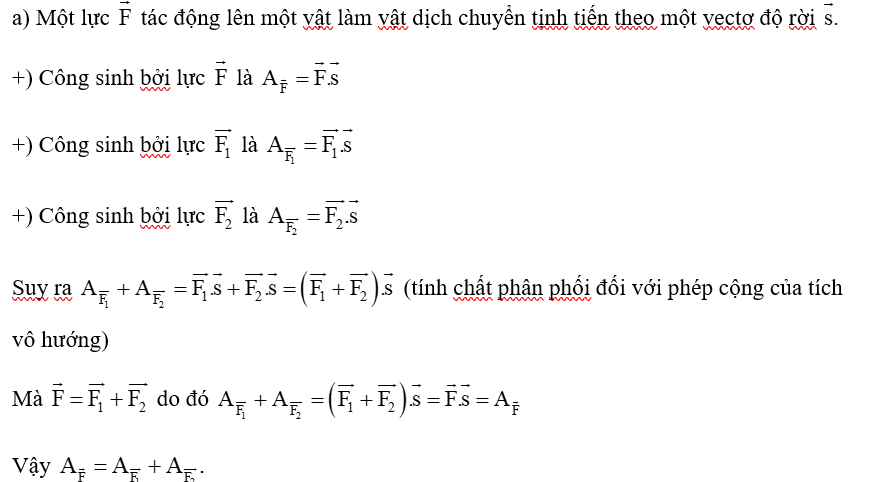
Hình minh hoạ

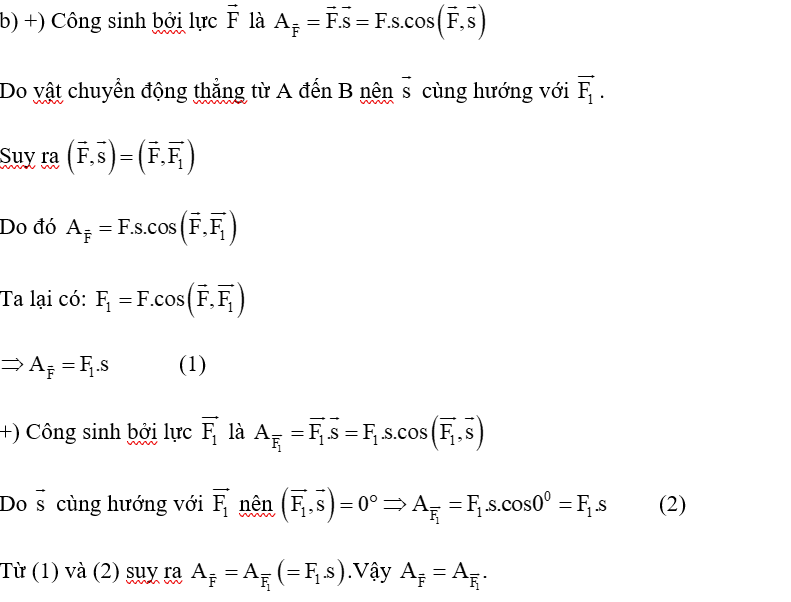
Hình minh hoạ

Câu 13

Hướng dẫn chấm do TopStudy biên soạn, mang tính gợi ý

a) Ta có: a→.b→=(−3).2+1.6=0⇒(a→,b→)=900.\overrightarrow{a}.\overrightarrow{b}=(-3).2+1.6=0\Rightarrow (\overrightarrow{a},\overrightarrow{b})={90}^{0}.

b) Ta có: a→.b→=3.2+1.4=10\overrightarrow{a}.\overrightarrow{b}=3.2+1.4=10

∣a→∣=32+12=10,∣b→∣=22+42=25|\overrightarrow{a}|=\sqrt{{3}^{2}+{1}^{2}}=\sqrt{10},|\overrightarrow{b}|=\sqrt{{2}^{2}+{4}^{2}}=2\sqrt{5}

a→.b→=∣a→∣.∣b→∣.cos(a→,b→)⇒cos(a→,b→)=a→.b→∣a→∣.∣b→∣=1010.25=12⇒(a→,b→)=450.\overrightarrow{a}.\overrightarrow{b}=|\overrightarrow{a}|.|\overrightarrow{b}|.c\text{os}(\overrightarrow{a},\overrightarrow{b})\Rightarrow c\text{os}(\overrightarrow{a},\overrightarrow{b})=\frac{\overrightarrow{a}.\overrightarrow{b}}{|\overrightarrow{a}|.|\overrightarrow{b}|}=\frac{10}{\sqrt{10}.2\sqrt{5}}=\frac{1}{\sqrt{2}}\Rightarrow (\overrightarrow{a},\overrightarrow{b})={45}^{0}.

c) Ta có: a→.b→=(−2).2+1.(−2)=−32\overrightarrow{a}.\overrightarrow{b}=(-\sqrt{2}).2+1.(-\sqrt{2})=-3\sqrt{2}

∣a→∣=(−2)2+12=3,∣b→∣=22+(−2)2=6|\overrightarrow{a}|=\sqrt{{(-\sqrt{2})}^{2}+{1}^{2}}=\sqrt{3},|\overrightarrow{b}|=\sqrt{{2}^{2}+{(-\sqrt{2})}^{2}}=\sqrt{6}

a→.b→=∣a→∣.∣b→∣.cos(a→,b→)⇒cos(a→,b→)=a→.b→∣a→∣.∣b→∣=−323.6=−1⇒(a→,b→)=1800.\overrightarrow{a}.\overrightarrow{b}=|\overrightarrow{a}|.|\overrightarrow{b}|.c\text{os}(\overrightarrow{a},\overrightarrow{b})\Rightarrow c\text{os}(\overrightarrow{a},\overrightarrow{b})=\frac{\overrightarrow{a}.\overrightarrow{b}}{|\overrightarrow{a}|.|\overrightarrow{b}|}=\frac{-3\sqrt{2}}{\sqrt{3}.\sqrt{6}}=-1\Rightarrow (\overrightarrow{a},\overrightarrow{b})={180}^{0}.

Câu 14

Hướng dẫn chấm do TopStudy biên soạn, mang tính gợi ý

a) Ta có: u→.v→=∣u→∣.∣v→∣.cos⁡(u→,v→)\overrightarrow{u}.\overrightarrow{v}=|\overrightarrow{u}|.|\overrightarrow{v}|.\cos (\overrightarrow{u},\overrightarrow{v})

Để u→.v→=∣u→∣.∣v→∣\overrightarrow{u}.\overrightarrow{v}=|\overrightarrow{u}|.|\overrightarrow{v}| thì cos⁡(u→,v→)=1⇔(u→,v→)=00\cos (\overrightarrow{u},\overrightarrow{v})=1\Leftrightarrow (\overrightarrow{u},\overrightarrow{v})={0}^{0}

Suy ra u→,v→\overrightarrow{u},\overrightarrow{v} là hai vecto cùng hướng.

b) Ta có: u→.v→=∣u→∣.∣v→∣.cos⁡(u→,v→)\overrightarrow{u}.\overrightarrow{v}=|\overrightarrow{u}|.|\overrightarrow{v}|.\cos (\overrightarrow{u},\overrightarrow{v})

Để u→.v→=−∣u→∣.∣v→∣\overrightarrow{u}.\overrightarrow{v}=-|\overrightarrow{u}|.|\overrightarrow{v}| thì cos⁡(u→,v→)=−1⇔(u→,v→)=1800\cos (\overrightarrow{u},\overrightarrow{v})=-1\Leftrightarrow (\overrightarrow{u},\overrightarrow{v})={180}^{0}

Suy ra u→,v→\overrightarrow{u},\overrightarrow{v} là hai vecto ngược hướng.

Câu 15

Hướng dẫn chấm do TopStudy biên soạn, mang tính gợi ý

a) Ta có: AM→(t−1;−2),BM→(t+4;−3)\overrightarrow{AM}(t-1;-2),\overrightarrow{BM}(t+4;-3)

⇒AM→.BM→=(t−1)(t+4)+(−2).(−3)=t2+3t+2.\Rightarrow \overrightarrow{AM}.\overrightarrow{BM}=(t-1)(t+4)+(-2).(-3)={t}^{2}+3t+2..

b) Để AMB^=900\widehat{AMB}={90}^{0} thì AM→.BM→=0\overrightarrow{AM}.\overrightarrow{BM}=0

⇔t2+3t+2=0⇔[t=−1t=−2\Leftrightarrow {t}^{2}+3t+2=0\Leftrightarrow [\begin{matrix}t=-1 \\ t=-2\end{matrix}

Vậy với t = -1 hoặc t = - 2 thì AMB^=900.\widehat{AMB}={90}^{0}.

Câu 16

Hướng dẫn chấm do TopStudy biên soạn, mang tính gợi ý

a) Ta có: AB→(6;3)⇒AB=62+32=35;\overrightarrow{AB}(6;3)\Rightarrow AB=\sqrt{{6}^{2}+{3}^{2}}=3\sqrt{5};

AC→(6;−3)⇒AC=62+(−3)2=35;\overrightarrow{AC}(6;-3)\Rightarrow AC=\sqrt{{6}^{2}+{(-3)}^{2}}=3\sqrt{5};

BC→(0;−6)⇒BC=02+(−6)2=6;\overrightarrow{BC}(0;-6)\Rightarrow BC=\sqrt{{0}^{2}+{(-6)}^{2}}=6;

Theo định lí cosin, ta có:

cosA=AB2+AC2−BC22.AB.AC=35⇒A^≈53,130;\text{cos}A=\frac{A{B}^{2}+A{C}^{2}-B{C}^{2}}{2.AB.AC}=\frac{3}{5}\Rightarrow \widehat{A}\approx 53,{13}^{0};

Tam giác ABC có AB = AC nên tam giác ABC cân tại A

⇒B^=C^=1800−A^2≈63,440\Rightarrow \widehat{B}=\widehat{C}=\frac{{180}^{0}-\widehat{A}}{2}\approx 63,{44}^{0}.

Vậy AB=AC=35,BC=6,A^=53,130,B^=C^=63,440.AB=AC=3\sqrt{5},BC=6,\widehat{A}=53,{13}^{0},\widehat{B}=\widehat{C}=63,{44}^{0}.

b) Gọi trực tâm H của tam giác ABC có tọa độ là H(x;y)

Khi đó, ta có: AH→(x+4;y−1);BC→(0;−6);BH→(x−2;y−4);AC→(6;−3)\overrightarrow{AH}(x+4;y-1);\overrightarrow{BC}(0;-6);\overrightarrow{BH}(x-2;y-4);\overrightarrow{AC}(6;-3)

Vì AH⊥BC⇒AH→.BC→=0⇔(x+4).0+(y−1).(−6)=0⇔y=1.AH\perp BC\Rightarrow \overrightarrow{AH}.\overrightarrow{BC}=0\Leftrightarrow (x+4).0+(y-1).(-6)=0\Leftrightarrow y=1.

Vì BH⊥AC⇒BH→.AC→=0⇔(x−2).6+(y−4).(−3)=0BH\perp AC\Rightarrow \overrightarrow{BH}.\overrightarrow{AC}=0\Leftrightarrow (x-2).6+(y-4).(-3)=0

⇔(x−2).2+(y−4).(−1)=0 ⇔2x−y=0\Leftrightarrow (x-2).2+(y-4).(-1)=0\ \Leftrightarrow 2x-y=0

Mà y = 1 ⇒2x−1=0⇔x=12.\Rightarrow 2x-1=0\Leftrightarrow x=\frac{1}{2}.

Câu 17

Hướng dẫn chấm do TopStudy biên soạn, mang tính gợi ý

Ta có: SABC=12AB.AC.sin⁡(AB→,AC→){S}_{ABC}=\frac{1}{2}AB.AC.\sin (\overrightarrow{AB},\overrightarrow{AC})

=12AB.AC.1−cos2(AB→,AC→)=\frac{1}{2}AB.AC.\sqrt{1-co{s}^{2}(\overrightarrow{AB},\overrightarrow{AC})}

=12AB.AC.1−(AB→.AC→)2AB→2.AC→2=\frac{1}{2}AB.AC.\sqrt{1-\frac{{(\overrightarrow{AB}.\overrightarrow{AC})}^{2}}{{\overrightarrow{AB}}^{2}.{\overrightarrow{AC}}^{2}}}

=12AB.AC.AB→2.AC→2−(AB→.AC→)2AB→2.AC→2=\frac{1}{2}AB.AC.\sqrt{\frac{{\overrightarrow{AB}}^{2}.{\overrightarrow{AC}}^{2}-{(\overrightarrow{AB}.\overrightarrow{AC})}^{2}}{{\overrightarrow{AB}}^{2}.{\overrightarrow{AC}}^{2}}}

=12AB.AC.1AB.AC.AB→2.AC→2−(AB→.AC→)2=\frac{1}{2}AB.AC.\frac{1}{AB.AC}.\sqrt{{\overrightarrow{AB}}^{2}.{\overrightarrow{AC}}^{2}-{(\overrightarrow{AB}.\overrightarrow{AC})}^{2}}

=12AB→2.AC→2−(AB→.AC→)2=\frac{1}{2}\sqrt{{\overrightarrow{AB}}^{2}.{\overrightarrow{AC}}^{2}-{(\overrightarrow{AB}.\overrightarrow{AC})}^{2}}

Câu 18

Hướng dẫn chấm do TopStudy biên soạn, mang tính gợi ý

MB2+ MC2=MA→2+MB→2+MC→2 =(MG→+GA→)2+(MG→+GB→)2+(MG→+GC→)2 =MG→2+2MG→.GA→+GA→2+MG→2+2MG→.GB→+GB→2+MG→2+2MG→.GC→+GC→2 =3MG→2+2MG→.(GA→+GB→+GC→)+GA→2+GB→2+GC→2 Tacoˊ:GA→+GB→+GC→=0→select:(tıˊnhcha^ˊttrọngta^mtamgiaˊc) ⇒MG→.(GA→+GB→+GC→)=MG→.0→=0 ⇒MA2+ MB2+ MC2=3MG→2+GA→2+GB→2+GC→2.{\mathrm{MB}}^{2}+\ {\mathrm{MC}}^{2}={\overrightarrow{\mathrm{MA}}}^{2}+{\overrightarrow{\mathrm{MB}}}^{2}+{\overrightarrow{\mathrm{MC}}}^{2}\ ={(\overrightarrow{\mathrm{MG}}+\overrightarrow{\mathrm{GA}})}^{2}+{(\overrightarrow{\mathrm{MG}}+\overrightarrow{\mathrm{GB}})}^{2}+{(\overrightarrow{\mathrm{MG}}+\overrightarrow{\mathrm{GC}})}^{2}\ ={\overrightarrow{\mathrm{MG}}}^{2}+2\overrightarrow{\mathrm{MG}}.\overrightarrow{\mathrm{GA}}+{\overrightarrow{\mathrm{GA}}}^{2}+{\overrightarrow{\mathrm{MG}}}^{2}+2\overrightarrow{\mathrm{MG}}.\overrightarrow{\mathrm{GB}}+{\overrightarrow{\mathrm{GB}}}^{2}+{\overrightarrow{\mathrm{MG}}}^{2}+2\overrightarrow{\mathrm{MG}}.\overrightarrow{\mathrm{GC}}+{\overrightarrow{\mathrm{GC}}}^{2}\ =3{\overrightarrow{\mathrm{MG}}}^{2}+2\overrightarrow{\mathrm{MG}}.(\overrightarrow{\mathrm{GA}}+\overrightarrow{\mathrm{GB}}+\overrightarrow{\mathrm{GC}})+{\overrightarrow{\mathrm{GA}}}^{2}+{\overrightarrow{\mathrm{GB}}}^{2}+{\overrightarrow{\mathrm{GC}}}^{2}\ \mathrm{Ta}\mathrm{có}:\overrightarrow{\mathrm{GA}}+\overrightarrow{\mathrm{GB}}+\overrightarrow{\mathrm{GC}}=\overrightarrow{0}\mathrm{select}:(\mathrm{tính}\mathrm{chất}\mathrm{trọng}\mathrm{tâm}\mathrm{tam}\mathrm{giác})\ \Rightarrow \overrightarrow{\mathrm{MG}}.(\overrightarrow{\mathrm{GA}}+\overrightarrow{\mathrm{GB}}+\overrightarrow{\mathrm{GC}})=\overrightarrow{\mathrm{MG}}.\overrightarrow{0}=0\ \Rightarrow {\mathrm{MA}}^{2}+\ {\mathrm{MB}}^{2}+\ {\mathrm{MC}}^{2}=3{\overrightarrow{\mathrm{MG}}}^{2}+{\overrightarrow{\mathrm{GA}}}^{2}+{\overrightarrow{\mathrm{GB}}}^{2}+{\overrightarrow{\mathrm{GC}}}^{2}.

Vậy MA2^{2} + MB2^{2} + MC2^{2} = 3MG2^{2} + GA2^{2} + GB2^{2} + GC2^{2}.