TopStudy

Tiếng Anh · Lớp 7

Bài tập Tiếng anh 7 Progress review 3 có đáp án

15 câu · 23 phút · Ngân hàng đề TopStudy. Đáp án và lời giải do TopStudy biên soạn, mở ngay dưới từng câu.

Làm bài

Nội dung đề

Phần I. Tự luận

Câu 1

1 điểm

Complete the dialogues with the words in the box (Hoàn thành các đoạn hội thoại với các từ trong hộp)

Hình minh hoạ

1. “What is the population of Viet Nam?” - "I guess it's more than 98 … people.”

2. “What's the hottest … in your country?” – “I know that one. It's July, or perhaps August.”

3. “What is 25% as a …?” – “We think it's a …”

4. “How far is the station from here?” – “It isn't very far. l'd say it's only about a …”

5. “Why was the year 2000 important?” – “It was the start of the new …”

6. “What do we need to make this big cake?” – “I reckon we need about a … of sugar”

7. “How fast can you run 100 …?” – “I can usually run it in 17 …”

8. “When was the artist Vincent Van Gogh born?” – “Maybe it was in the 19 … but I'm not sure.”

Xem đáp án và lời giải

Hướng dẫn chấm do TopStudy biên soạn, mang tính gợi ý

1. million2. month3. fraction – quarter4. kilometre
5. millennium6. kilo7. metres – seconds8. century

Hướng dẫn dịch:

1. "Dân số Việt Nam là bao nhiêu?" - "Tôi đoán là hơn 98 triệu người."

2. "Tháng nóng nhất ở quốc gia của bạn là gì?" - "Tôi biết điều đó. Đó là tháng Bảy, hoặc có lẽ là tháng Tám. ”

3. "25% là một phân số là gì?" - "Chúng tôi nghĩ đó là một phần tư."

4. "Nhà ga từ đây bao xa?" - “Nó không xa lắm. Tôi sẽ nói rằng nó chỉ khoảng một km. "

5. "Tại sao năm 2000 lại quan trọng?" - "Đó là sự khởi đầu của thiên niên kỷ mới."

6. "Chúng ta cần những gì để làm ra chiếc bánh lớn này?" - "Tôi nghĩ chúng ta cần khoảng một kg đường"

7. "Bạn có thể chạy 100 mét nhanh đến mức nào?" - "Tôi thường có thể chạy nó trong 17 giây."

8. "Nghệ sĩ Vincent Van Gogh sinh năm nào?" - "Có thể là vào thế kỷ 19 nhưng tôi không chắc."
Câu 2

1 điểm

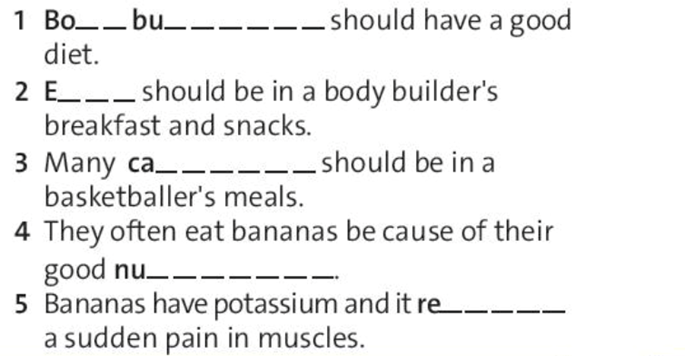
Complete the words (Hoàn thành các từ)

Hình minh hoạ

Xem đáp án và lời giải

Hướng dẫn chấm do TopStudy biên soạn, mang tính gợi ý

1. Bodybuilders

2. Eggs

3. calories

4. nutrition

5. reduces

Hướng dẫn dịch:

1. Người tập thể hình nên có một chế độ ăn uống tốt.

2. Trứng nên có trong bữa sáng và bữa ăn nhẹ của người xây dựng cơ thể.

3. Nên có nhiều calo trong bữa ăn của vận động viên bóng rổ.

4. Họ thường ăn chuối là vì họ có dinh dưỡng tốt.

5. Chuối có kali và nó làm giảm cơn đau đột ngột ở các cơ.

Câu 3

1 điểm

Complete the sentences by making comparisons. (Hoàn thành các câu bằng cách so sánh.)

1. This book about football stars is similar … the book I bought last week.

2. That volleyball player was amazing. He was … (fast) as a tiger.

3. The seats in this stadium are great. They are … (comfortable) than our chairs.

4. Robbie gets up late and he never does any sport. He's … (lazy) person I know.

5. The new swimming pool is very large. It's different … the old pool.

6. This race is very difficult. It's not … (easy) as the long race last year.

7. That match is bad! It doesn't attract … (many) viewers as the one I saw.

Xem đáp án và lời giải

Hướng dẫn chấm do TopStudy biên soạn, mang tính gợi ý

1. to2. as fast3. more comfortable4. the laziest
5. from6. as easy7. as many

Hướng dẫn dịch:

1. Cuốn sách về các ngôi sao bóng đá này tương tự như cuốn sách tôi đã mua tuần trước.

2. Cầu thủ bóng chuyền đó thật tuyệt vời. Anh ta nhanh như hổ.

3. Chỗ ngồi trong sân vận động này thật tuyệt. Chúng thoải mái hơn ghế của chúng tôi.

4. Robbie dậy muộn và anh ấy không bao giờ chơi bất kỳ môn thể thao nào. Anh ấy là người lười nhất mà tôi biết.

5. Hồ bơi mới rất rộng. Nó khác với hồ bơi cũ.

6. Cuộc đua này rất khó khăn. Nó không dễ dàng như cuộc đua dài năm ngoái.

7. Trận đấu đó thật tệ! Nó không thu hút nhiều người xem như cái mà tôi đã xem.

Câu 4

1 điểm

Listen to the radio programme. Then tick (V) the boxes (Nghe chương trình radio. Sau đó đánh dấu (V) vào các ô)

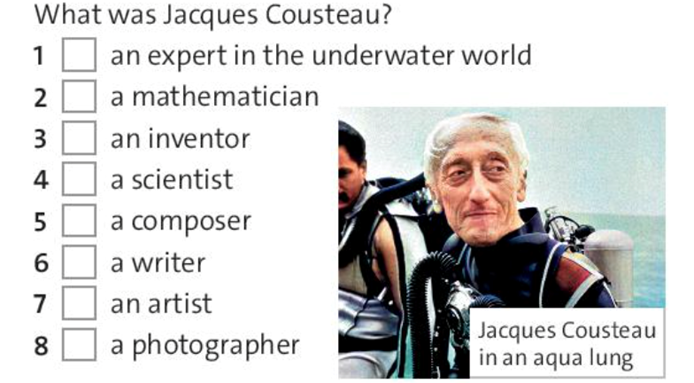
What was Jacques Cousteau?

Hình minh hoạ

Xem đáp án và lời giải

Hướng dẫn chấm do TopStudy biên soạn, mang tính gợi ý

1, 3, 4, 6, 8

Nội dung bài nghe:

This week in Great Lives, we’re looking at the life of one of the most famous French men of the 20th^{th} century – Jacques Cousteau. As many people know, Cousteau was an expert in the underwater world, but he did many other things in his life, too. He was born in 1910, and he learned to swim when he was four. As a child, he could swim very well, and he always loved the sea. When he was a teenager, he went to a special school to learn about boats and sailing, and he later travelled a lot by sea. He was a very creative person, and in 1943 he became an inventor. He invented the aqua lung with a friend. This is a special thing to help people swim under the water for a long time. In 1950, he bought a boat called the Calypso, and he began to work as a scientist studying the life of underwater animals and plants. And in 1953, he wrote his first book called “The silent world.” Cousteau was not only the writer of this book, but he took many of the photographs for it too. He was an excellent underwater photographer, and he took many wonderful pictures over the years. Between 1966 and 1976, people in different countries could watch his famous TV series “The underwater world of Jack Cousteau”, and he became one of the most famous TV personalities in the world. After a long and interesting life, he died in Paris in 1997.

Hướng dẫn dịch:

Tuần này trong Great Lives, chúng ta sẽ tìm hiểu về cuộc đời của một trong những người đàn ông Pháp nổi tiếng nhất thế kỷ 20 - Jacques Cousteau. Như nhiều người đã biết, Cousteau là một chuyên gia về thế giới dưới nước, nhưng ông ấy cũng đã làm nhiều thứ khác trong cuộc đời mình. Ông sinh năm 1910 và học bơi khi mới 4 tuổi. Khi còn nhỏ, ông ấy có thể bơi rất giỏi, và ông ấy luôn yêu thích biển. Khi còn là một thiếu niên, ông đã đến một trường học đặc biệt để học về thuyền và chèo thuyền, và sau đó ông đã đi rất nhiều nơi bằng đường biển. Ông là một người rất sáng tạo, và vào năm 1943, ông đã trở thành một nhà phát minh. Ông ấy đã cùng một người bạn phát minh ra phổi thủy sinh. Đây là một điều đặc biệt giúp con người có thể bơi dưới nước rất lâu. Năm 1950, ông mua một chiếc thuyền có tên là Calypso và bắt đầu làm nhà khoa học nghiên cứu đời sống của các loài động vật và thực vật dưới nước. Và vào năm 1953, ông viết cuốn sách đầu tiên của mình mang tên “Thế giới im lặng”. Cousteau không chỉ là người viết cuốn sách này mà còn chụp rất nhiều bức ảnh cho cuốn sách này. Ông ấy là một nhiếp ảnh gia dưới nước xuất sắc, và ông ấy đã chụp được nhiều bức ảnh tuyệt vời trong nhiều năm. Từ năm 1966 đến năm 1976, người dân ở các quốc gia khác nhau có thể xem bộ phim truyền hình nổi tiếng của ông “Thế giới dưới nước của Jack Cousteau” và ông đã trở thành một trong những nhân vật truyền hình nổi tiếng nhất thế giới. Sau một cuộc sống dài và thú vị, ông qua đời tại Paris vào năm 1997.

Câu 5

1 điểm

Complete the sentences using “can, can't, could” or “couldn't” (Hoàn thành các câu sử dụng “can, can't, could” và “couldn't”)

1. … that child prodigy play the piano when she was two?

2. The boy on TV now … remember 1,000 different numbers - he's amazing!

3. My little sister … write any words at the moment, but she can read easy sentences.

4. We ... play tennis when we were ten, but we're good at it now.

5. That famous artist … paint well at an early age.

6. How many languages … your cousin speak now?

Xem đáp án và lời giải

Hướng dẫn chấm do TopStudy biên soạn, mang tính gợi ý

1. Could

2. can

3. can’t

4. couldn’t

5. could

6. can

Hướng dẫn dịch:

1. Liệu thần đồng nhí đó có thể chơi piano khi cô ấy hai tuổi không?

2. Cậu bé trên TV giờ có thể nhớ 1.000 con số khác nhau - cậu ấy thật tuyệt vời!

3. Em gái của tôi hiện không thể viết bất kỳ từ nào, nhưng cô ấy có thể đọc những câu dễ.

4. Chúng tôi không thể chơi quần vợt khi chúng tôi lên mười, nhưng chúng tôi đã chơi tốt môn này.

5. Nghệ sĩ nổi tiếng đó có thể vẽ tốt khi còn nhỏ.

6. Bây giờ anh họ của bạn có thể nói được bao nhiêu ngôn ngữ?

Câu 6

1 điểm

Complete the questions with “How” and the words in the box. (Hoàn thành các câu hỏi với "How" và các từ trong khung)

Hình minh hoạ

1. “… books do you read every year?” – “Over forty. I'm a child prodigy!”

2. “.... can you run in an hour?” – “About six kilometres.”

3. “… are you now?” – “I'm one metre seventy.”

4. “… homework do you do? – “Quite a lot!”

5. “… is Adam?” – “He's fourteen.”

6. “… is that young film star?” – “I don't know, but he's got more money than me!”

Xem đáp án và lời giải

Câu 7

1 điểm

Complete the dialogue and practice with your partner. (Hoàn thành cuộc đối thoại và thực hành với bạn của bạn.)

Hình minh hoạ

Tina: This “phở” is amazing, Mai! When did you learn how to cook like that?

Mai: My mum showed me how to make “phở” about six months ago.

Tina: I love Vietnamese cooking, but I'm no good. (1) to learn?

Mai: (2) learn from somebody in your family.

Tina: (3) nobody in my family can make Vietnamese food.

Mai: (4) watch videos online.

Tina: I suppose so.

Mai: Or you can have some cooking lessons.

Tina: (5)

Mai: Or perhaps I can teach you and we can eat “phở” together!

Tina: (6)

Xem đáp án và lời giải

Câu 8

1 điểm

Order the words to make sentences. Then match the sentences with the questions below (Sắp xếp các từ để tạo thành câu. Sau đó nối các câu với các câu hỏi bên dưới)

Enid Blyton

1. British / writer / was / Enid Blyton / a

2. born / was / 1891 / England / in / She / in

3. sixteen / when / was / she / writing / She first / started

4. became / Enid Blyton / eventually / the / famous/ most / of / writer / children's stories

5. loved / People / her work / were / her mysteries / because / exciting / so

A. Who was Enid Blyton?

B. What did she become?

C. Where was she born?

D. Why were her books popular?

E. When did she first start writing?

Xem đáp án và lời giải

Câu 9

1 điểm

Complete the sentences with the words in the box (Hoàn thành các câu với các từ trong hộp)

Hình minh hoạ

1. Before it's dark, you need to … a new shelter with branches.

2. If you see a big bear, try to … still.

3. If you're afraid, you can … up a tree.

4. Look for a river if you want to … some drinking water.

5. You can always … away quickly from animals.

6. Don't … strange fruit.

7. If you … the sun, you can find out where you are. You don't need a map!

8. Remember to … all dangerous plants.

Xem đáp án và lời giải

Câu 10

1 điểm

Complete the personality adjectives in the text. (Hoàn thành các tính từ chỉ tính cách trong văn bản.)

If you want to do well on a TV survival programme, you need the right personal qualities. First of all, it's important to want to win - you need to be (1). It also helps if you're (2) because you need to climb trees and run away from crocodiles! It's useful to be intelligent, creative and (3). Don't forget to work in a team and listen to others - nobody likes a (4) person! If people like you, they will help you, so don't be too quiet and (5). It's always important to be (6).

Xem đáp án và lời giải

Câu 11

1 điểm

Complete the sentences with the correct form of the verbs. (Hoàn thành các câu với dạng đúng của động từ.)

1. If she (eat) that dangerous fruit, she (feel) very ill.

2. I (stay) in the shelter if it (rain).

3. If they (not work) hard, they (not win) the survival competition.

4. We (not get) cold if we (take) warm coats.

5. If he (see) a lion, he (be) afraid.

6. Charlie (get) better if he (drink) some water,

7. If you (finish) your homework in time, (you / watch) that adventure programme on TV?

8. What (we / do) if we (lose) our map?

Xem đáp án và lời giải

Câu 12

1 điểm

Listen to the conversation between Alex and his dad. Complete the sentences below. (Hãy lắng nghe cuộc trò chuyện giữa Alex và bố của anh ấy. Hoàn thành các câu dưới đây.)

Alex …

1. has got two … in his bag.

2. has got a new …

3. hasn't got a …

4. needs to buy a …

5. doesn't want to take a …

6. can't put the big … in his bag.

Xem đáp án và lời giải

Câu 13

1 điểm

Complete the sentences with “must, mustn't, should” or “shouldn't” (Hoàn thành các câu với “must, mustn't, should” hoặc “shouldn't”)

1. We … swim in the sea today. The weather is very bad and there's a red flag.

2. The exams are finished now. You … relax and have a nice time with your friends.

3. You … eat in the library. That's the rule.

4. We … arrive on time for lessons every day. It's very important.

5. You … go to bed late. It isn't a good idea.

6. We … cycle to school every day. It's cheaper than the bus.

7. You … buy that book. It isn't very good.

Xem đáp án và lời giải

Câu 14

1 điểm

Complete the dialogue with the phrases. There is one extra phrase (Hoàn thành cuộc đối thoại với các cụm từ. Có một cụm từ thừa)

Hình minh hoạ

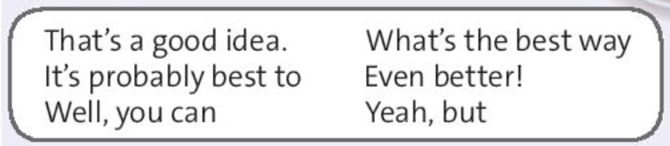
Instructor: Hi! Welcome to the climbing wall. There are a few important things to say before you start. Firstly (1) watch some climbing videos on YouTube. They're useful.

Ethan: Cool. (2) to do that.

Instructor: Then, (3) you always wear a helmet when you're here.

Ethan: OK. I'll put my helmet on now.

Instructor: And keep away from other climbers below you on the wall. (4) kick their hands.

Ethan: OK, but what do you think will happen if I fall?

Instructor: Don't worry, you won't fall. We use ropes. (5) if you climb with ropes.

Xem đáp án và lời giải

Câu 15

1 điểm

Put the paragraphs in the suitable order (Đặt các đoạn văn theo thứ tự phù hợp)

A. You should start studying early for the exams. Don't wait until the last minute! If you need help with anything, you should speak to your teacher.

B. On the day of the exam, it's important to arrive early. You don't want to be late. Don't panic if you find some questions difficult! If you read them again, you'll understand them.

C. Exams are a big part of life and here are my tips for surviving them.

D. Always pay attention in class and listen to the teacher. It's a good idea to write careful notes in lessons. They'll be useful when you want to revise.

Xem đáp án và lời giải

Tất cả đề Progress review · Các bộ sách Tiếng Anh Lớp 7